
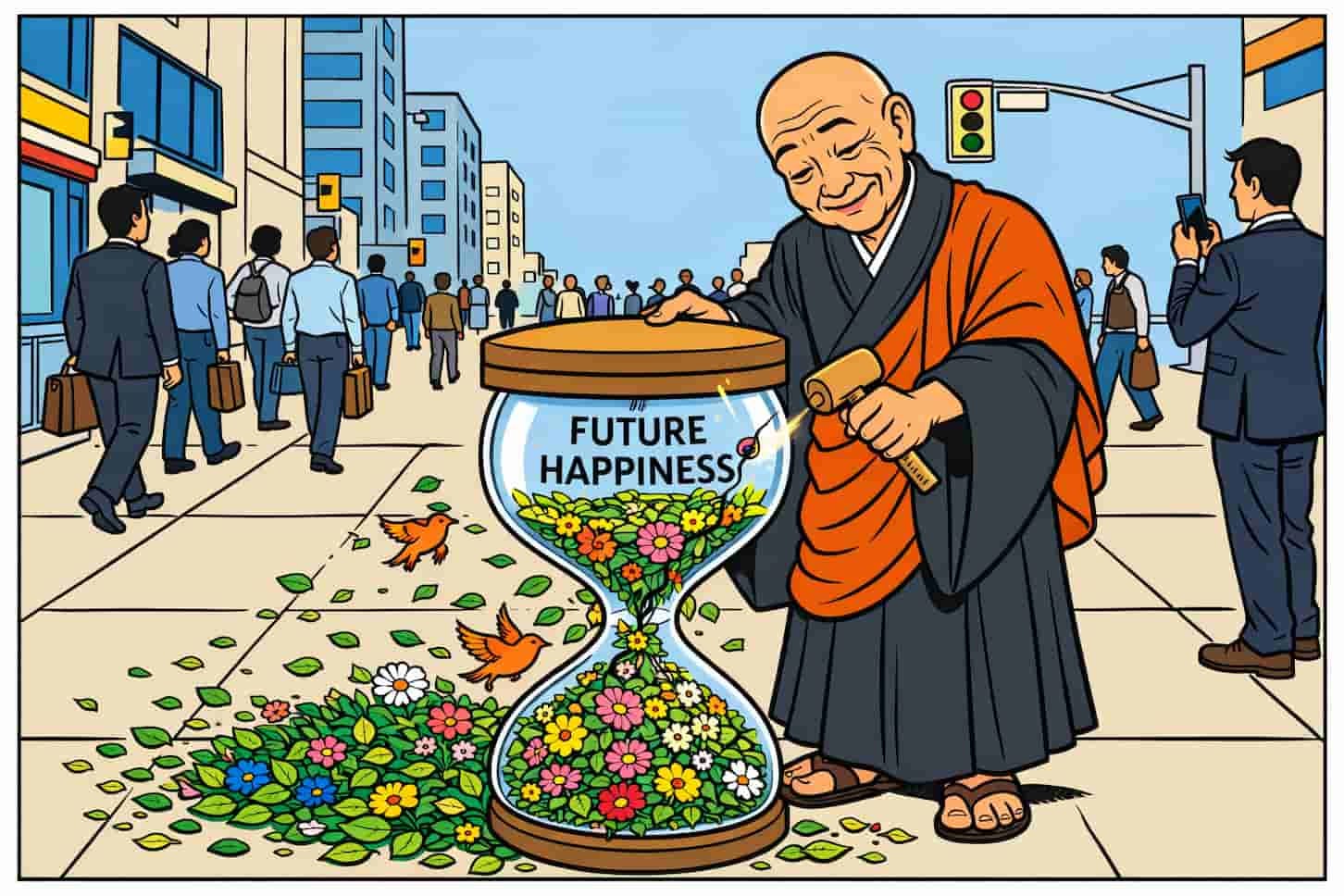
I had a colleague once. Let’s call him Mark, because naming him “Sisyphus Pushing a Boulder Made of Spreadsheets” seemed a bit on the nose.
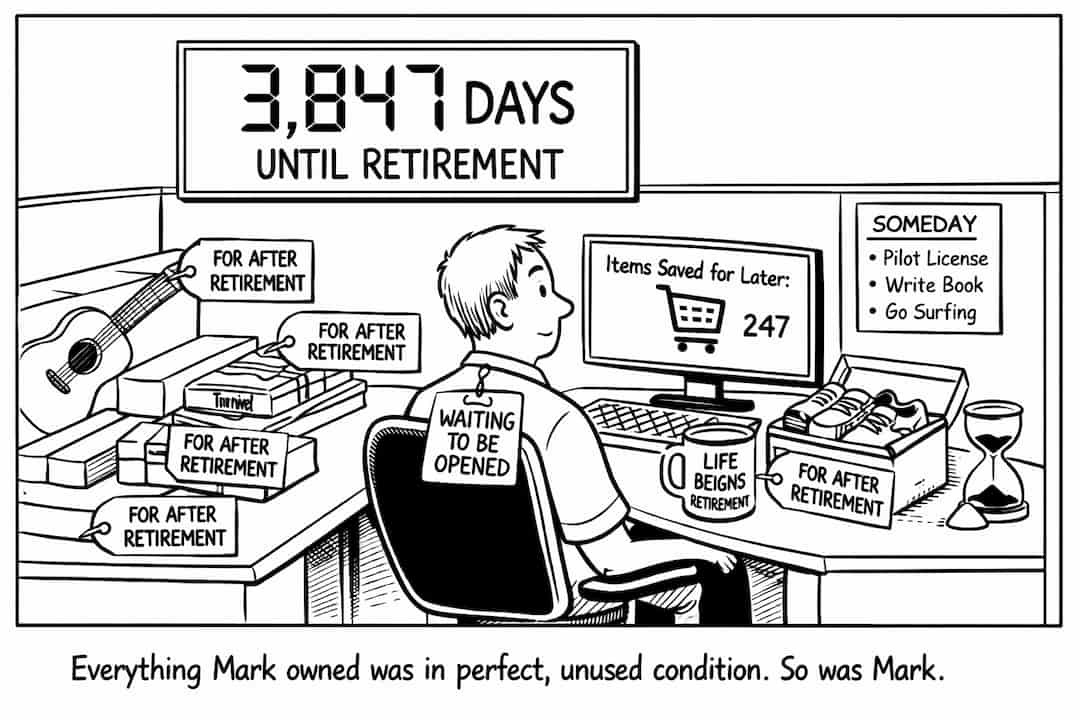
Mark coded a countdown timer on his desktop. Not for a deadline, but for retirement. 3,847 days.
Every morning he’d glance at it like a man watching paint dry in real-time—except the paint was his entire existence, drying at the speed of continental drift.
“When this hits zero,” he’d say, with the wistful tone of someone describing a soulmate, “then I’ll finally be free.”
The cruel irony? That belief was the very thing keeping him imprisoned. Mark wasn’t counting down to freedom. He was counting down to the same Mark, just older, with less hair, still convinced that happiness is always one more milestone away.
The “I’ll Be Happy When…” Trap
Do you have a version of Mark’s timer? Maybe not be on your desk, but it’s running in the background like a browser tab you forgot to close, quietly draining your battery.
“I’ll be happy when I get promoted.”
“I’ll start living when I quit this job.”
“I’ll be free when I hit that savings target / move to Austin / finally understand what Bitcoin actually is.”
It sounds responsible, doesn’t it? It’s the core of the Western Dream: suffer through the grind now to unlock the Good Life later. We’ve turned waiting for happiness into an Olympic event, and we’re all going for gold.
But here’s what actually happens: You treat the present as something to endure rather than inhabit.
You become a passenger in the world’s longest airport layover, convinced that real life is always one connection away.
Worse, when you finally reach that milestone, you discover something unsettling: You’re still you.
You have the same anxieties and the same restlessness—just with better furniture and a marginally less depressing view. So, you reset the timer. You become a hostage negotiator in which you are both the hostage and the negotiator, and the ransom is your entire existence.
Why “Freedom Later” is a Lie
The uncomfortable truth is freedom isn’t a destination; it’s a relationship you cultivate with the life you already have.
You are not a prisoner waiting for parole. You’ve just convinced yourself the cell door is locked when it’s actually just heavy—made of bureaucracy, expectations, and the fear of disappointing people.
But time never honors that deal. There is no escrow account where your suffering accrues interest. The only moment you actually have to be free is this one. Right now. While you’re still in the grey cubicle designed by someone who thinks “ergonomic” means “vaguely less likely to cause spinal damage.”
I’m saying something more radical: Freedom starts now, or it starts never.
The Paradox Unpacked
The more you postpone freedom, the more you reinforce your imprisonment.
When you tell yourself “I’ll be free when I quit,” you teach yourself that your current life is something to escape. When escape becomes your primary relationship with reality, you stop looking for ways to be free inside it.
You stop noticing the small rebellions that actually constitute a life:
The ten minutes of silence on a commute where you aren’t performing productivity.
The satisfaction of finishing a task cleanly, even if nobody notices.
The boundary you set with a coworker who thinks your inbox is their personal therapy session.
You stop training the muscle of freedom because you’ve outsourced it to a future version of yourself. But that future version never shows up because they are you, and you are still stuck in the pattern of deferral.
The Dojo of the Present
The people who feel most free aren’t those who’ve escaped their circumstances. They aren’t the ones who moved to Bali to find themselves or started a podcast about “authenticity.”
They are the ones who realized their job isn’t a prison—it’s a dojo. It’s their art studio.
It’s a training ground for patience, discipline, attention, and boundaries. They are the ones who stopped waiting for perfect conditions and started finding freedom in the cracks. They reclaimed their attention from the tyranny of urgency and decided to eat lunch like a human being instead of inhaling a “sad desk salad” while muted on a Zoom call.
They asked: “What if I practiced being free here, right now, in the middle of the mess?”
The Invitation
What if you stopped waiting? What if, instead of counting down the days until you can finally live, you started practicing freedom today?
Not by burning it all down in a blaze of glory—that makes for a great story but a difficult bank statement. But by waking up inside your own life and asking: “Where am I already free, and where am I choosing to stay caged?”
Maybe it’s the way you check email compulsively, as if responding within thirty seconds proves your worth. Maybe it’s the way you say “yes” to pointless meetings because you’re afraid of looking “uncommitted.” Maybe it’s the way you collapse onto the sofa every night, too drained to do what you actually love because you spent all day performing busyness instead of practicing excellence.
Those are choices. They are small, but they are yours.
The moment you stop negotiating with your existence and start inhabiting it, something shifts. You might still be in the same job and the same commute, listening to the same productivity podcast. But you’re no longer waiting to be free.
You already are. Class is in session.
Practice for the Week:
What is one ‘misery token’ you’re tired of trading for a future that never arrives?