
Misery Is a Skill
There’s a moment every Monday morning, somewhere between the third snooze alarm and the cold realization that weekends are a government-sponsored hallucination designed to keep you just functional enough to generate shareholder value, when most of us feel it.
That dull, familiar weight. The one that settles into your chest like a burrito you regret.
The commute. The fluorescent lights make everyone look like they’re dying of tuberculosis in a 1990s Lifetime movie. Your inbox is already bloated with emails from people who type “Per my last email” like they’re unsheathing a katana.
And in that moment, a quiet rebellion starts whispering: This isn’t the life I wanted. This job is draining me. If I could just escape this, I’d finally be free.
Here’s the uncomfortable truth I had to learn the hard way: Your job isn’t killing your potential. Your relationship with your job is.
And until you change that relationship, no amount of escape fantasies will save you. You could win the Powerball tomorrow, and you’d still find a way to be miserable, because misery isn’t a location. It’s a skill. And you’ve been practicing it eight hours a day, five days a week, like you’re training for the Olympics of Despair.
The Great Escape That Never Arrives
I used to think freedom was something you earn after work.
You grind through the boring meetings. You survive the soul-crushing spreadsheets. You stockpile enough money, time, or courage, and then, one glorious day, you break free. You quit. You move to Tulum. You finally live, preferably while wearing linen pants and making eye contact with a beautiful stranger over cold brew.
The problem? That day never comes.
It never comes because while you’re waiting for conditions to be perfect, you’re spending eight hours a day practicing frustration, resentment, and the kind of disengagement usually reserved for teenagers forced to attend their aunt’s second wedding.
You’re not saving energy for your real life. You’re training yourself to be miserable, with the dedication of a Navy SEAL doing Hell Week, except instead of emerging as an elite warrior, you emerge as someone who sighs audibly at breakfast.
What if I told you that same cubicle, that same commute, that same inbox full of passive-aggressive requests from Kevin in Compliance, could be the very thing that sets you free?
I know. I know. That sounds like something a LinkedIn influencer would say right before trying to sell you a course. Bear with me.
Enter the Dojo
In martial arts, a dojo isn’t a spa retreat. It’s not comfortable. It’s not a place where someone hands you a cucumber water and asks about your intentions. It’s where you get your ego handed to you, repeatedly, until something inside you changes or breaks, whichever comes first.
The sensei doesn’t let you skip the hard parts because you had a rough childhood. The other students don’t care about your excuses. The training is uncomfortable by design, because that’s what forges discipline.
Pain is the curriculum. Discomfort is the homework.
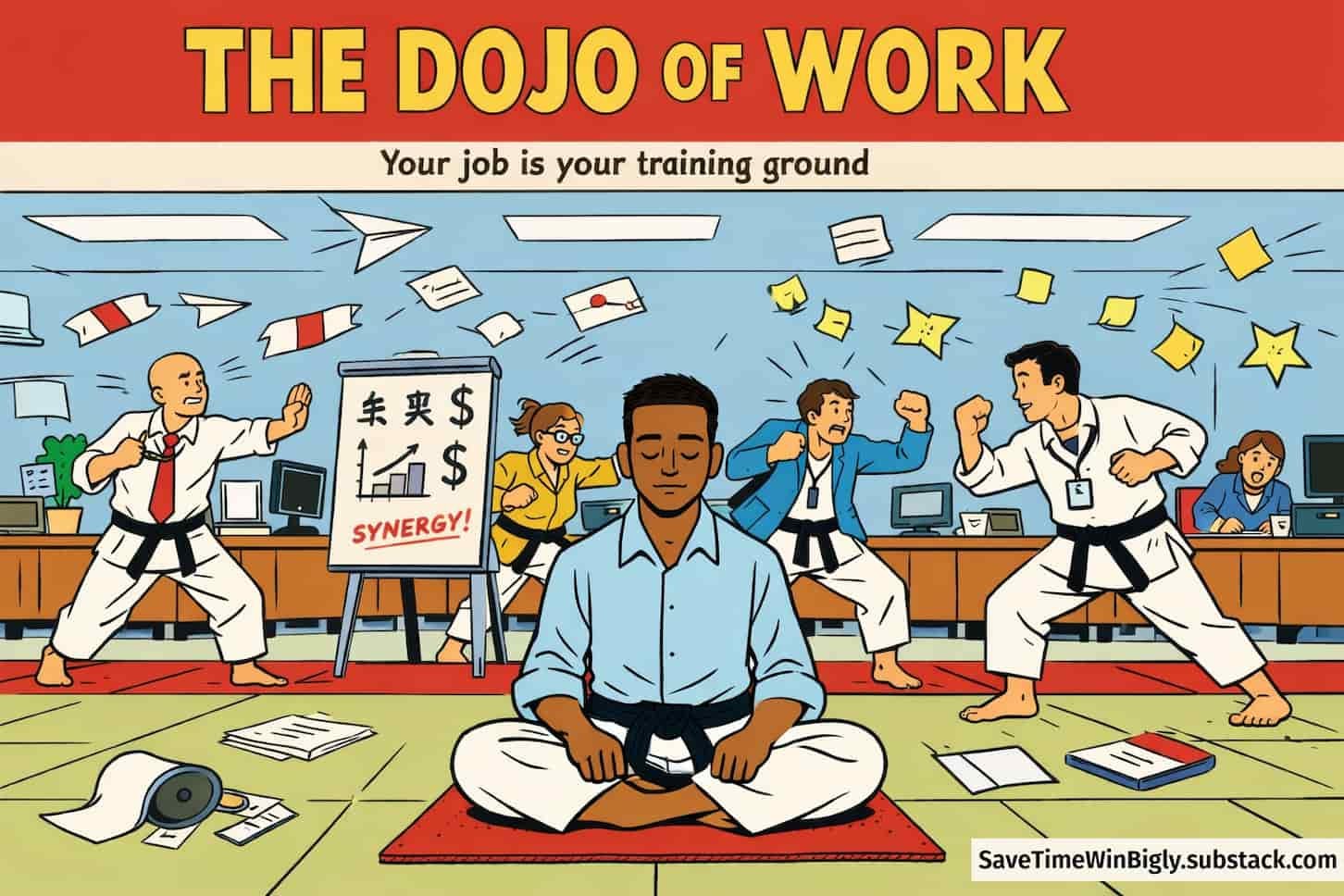
Your job is the same thing.
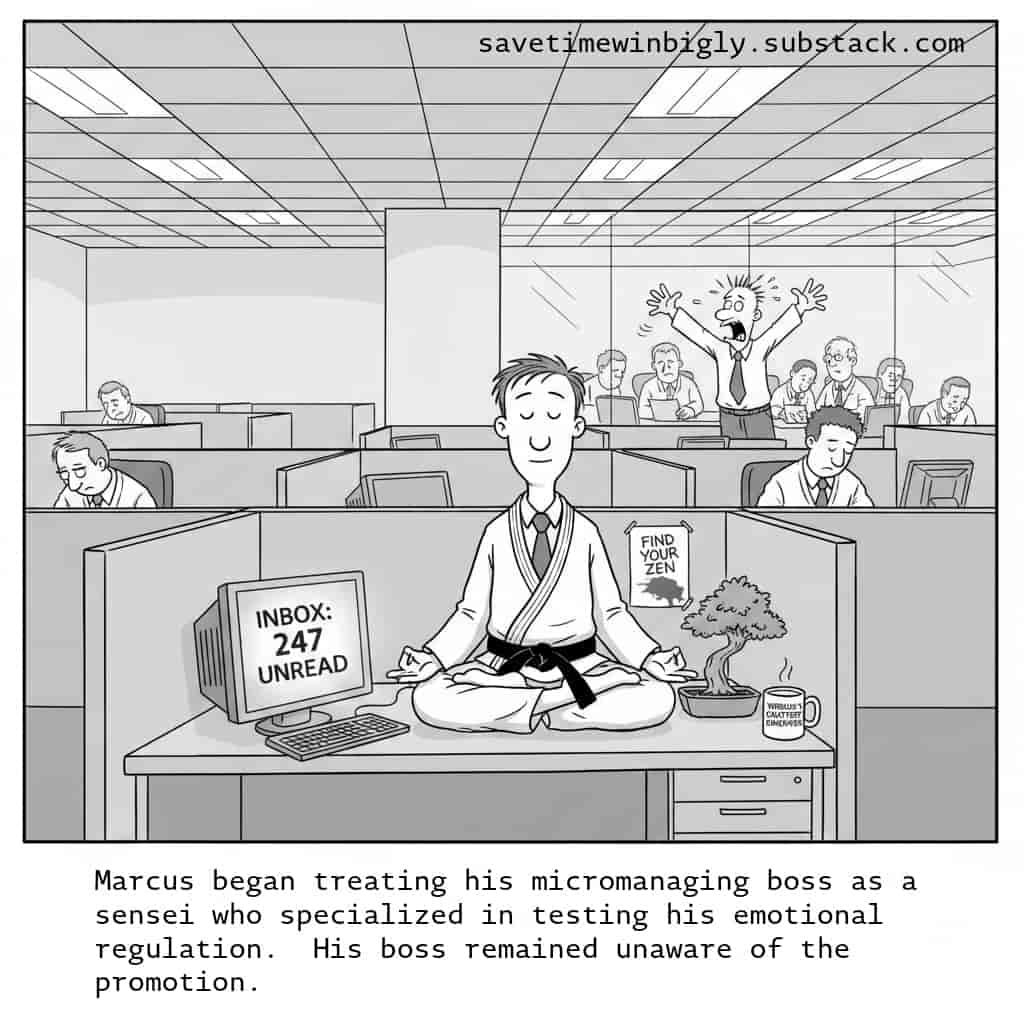
That micromanaging boss who schedules check-in meetings to discuss the check-in meetings? That’s your patience exam.
The coworker who never listens, who just waits for your mouth to stop moving so they can say the thing they were going to say anyway? Your boundaries course. Advanced level.
The meeting that could have been an email? A meditation in letting go of things you can’t control, like why Sharon needed forty-five minutes to say “let’s circle back next week.”
You’re not stuck in traffic. You’re training in traffic.
You’re not waiting for your manager to finish a pointless monologue about synergy. You’re practicing the ancient art of emotional regulation, the kind Buddhist monks spend decades cultivating on mountaintops, except you’re doing it in a conference room that smells like old coffee and broken dreams.
Your job is your dojo. Whether you signed up for it or not.
The Uncomfortable Shift
I know what you’re thinking: “That sounds like toxic positivity with extra steps. You want me to pretend my frustrating job is actually good for me? What’s next, gratitude journaling about my printer jams?”
No.
I’m not asking you to love your job. I’m asking you to stop fighting a war you can’t win, the war against reality, and start winning the one that matters.
Because here’s what happens when you treat work as a training ground instead of a prison sentence:
You stop burning energy on resistance. Every time you mentally check out, complain internally, or count the hours until 5 PM like a hostage marking days on a cell wall, you’re spending energy you could use elsewhere. Acceptance isn’t surrender. It’s strategy. It’s the difference between swimming against the current until you drown and turning sideways to find the easier path.
You start seeing feedback everywhere. What things annoy you most about work? They’re not random torture sent by a capricious universe that specifically hates you. They’re mirrors. That colleague who talks over you reveals where your assertiveness needs work.
That boring task you avoid exposes your relationship with discipline. The dojo shows you exactly what you need to train. It’s like having a personal development coach, except instead of paying twelve thousand dollars for a weekend retreat, you just show up to work and pay attention.
Reclaim your power. When you’re waiting for external circumstances to change before you can feel good, you’ve handed your wellbeing to things you don’t control. You’ve made your peace of mind contingent on your boss’s mood, your company’s stock price, and whether Mercury is in retrograde.
When you decide that you are the thing being forged, that the circumstances are just the hammer and you’re the blade, you take that power back. You become the protagonist instead of the victim, which is considerably less satisfying to complain about at brunch but much more useful for actual life.
A Day in the Dojo
Let’s make this concrete.
You wake up. The alarm feels like a personal insult, a small box screaming at you that capitalism requires your presence. Instead of scrolling through Instagram looking at people who seem to have better lives, which is basically giving yourself a wedgie for your soul, you notice the resistance. You acknowledge it. You get up anyway. Training in discipline: Day 1.
On the commute, someone cuts you off with the kind of aggressive entitlement usually reserved for reality TV villains. Your blood pressure spikes. You can feel a revenge fantasy forming, something involving their car and a very specific pothole. But instead of replaying that fantasy for twenty minutes like a deranged movie director, you notice the anger, let it pass like a cloud, and return to whatever podcast is playing. Training in equanimity: Rep 1.
At work, your inbox is a disaster. It looks like someone emptied a dumpster into your email. You want to procrastinate. You feel the pull toward “just checking” social media, toward Twitter, toward literally anything that isn’t the hard thing in front of you. But you take one breath, pick the most important item, and start. Just start. Training in focus: Beginner level. The black belt comes later.
In the afternoon meeting, someone takes credit for your idea. Just straight up steals it, like a seagull snatching a French fry from your hand, except the French fry is your intellectual labor. The old you would stew for hours, composing scathing emails you’d never send and imagining their eventual comeuppance. The dojo-trained you notes the injustice, decides whether to address it now or later, and either way doesn’t let it colonize the rest of your day like an invasive species of resentment. Training in emotional economy: Intermediate.
You leave work at a reasonable hour. Not because there’s nothing left to do, there’s always more to do, the to-do list is a hydra that grows two heads every time you check something off, but because you’ve learned that martyrdom isn’t productivity. Working until midnight doesn’t make you dedicated. It makes you someone who works until midnight and then complains about it, which is its own special kind of tragedy. Training in boundaries: Advanced.
By the time you get home, something strange has happened. You’re not drained. You’re not depleted. You don’t collapse onto the couch like a Victorian woman with the vapors. Because you spent the day training instead of fighting.
And now you have energy for the things that actually matter to you.
But What About Actually Escaping?
Here’s the beautiful paradox, the plot twist that makes this whole dojo thing genuinely useful rather than just a reframe to help you cope with mediocrity:
The better you get at treating your job as a dojo, the more likely you are to eventually leave it. On your terms, at a time of your choosing, with skills and savings and sanity intact.
Because the skills you build while accepting your work are the exact same skills you need to transcend it:
Discipline to stick with hard projects when the initial enthusiasm wears off, and you’re left staring at a half-finished thing that mocks you.
Focus on doing deep work in a world designed to fragment your attention into a million tiny pieces, each one competing for the real estate inside your skull.
Boundaries to protect your time from people who treat “quick question” as a legally binding invitation to take forty-five minutes of your life.
Equanimity to weather setbacks without catastrophizing every disappointment into evidence that the universe is out to get you specifically.
Self-awareness to know what you actually want, which is harder than it sounds when you’ve spent years chasing metrics that someone else defined as success.
The dojo doesn’t trap you. It prepares you for takeoff.
The Real Question
This is the first phase of what I call the Runway Framework, the path from Overworked to Awake to Free.
And it starts with a simple question:
If your job is your dojo, what is it trying to teach you right now?
Not what you wish it would teach you. Not what would be convenient. What is it actually showing you about yourself? Your patience, your discipline, your ability to be present when you’d rather be anywhere else, including asleep, or on a beach, or asleep on a beach?
Because the moment you stop running from work and start learning from it, everything changes.
You’re no longer a prisoner of circumstance, pressing your face against the bars and wondering when freedom will arrive like some kind of emotional DoorDash.
You’re a student of your own life.
And class is in session.
Welcome to the dojo. Bow before entering.
Forward this to someone who’s still negotiating with their alarm clock every Monday. They might need the dojo more than they know.
Read more about the Runway Framework using the link below.
The Runway Framework: From Overworked to Awake to Free

Right, let’s get something straight. Your job isn’t killing you. Your job is doing exactly what jobs do. It’s sitting there, being a job, radiating fluorescent light and passive-aggressive Slack messages like some kind of corporate space heater. Subscribe. It won't fix your job, but it'll make the suffering funnier.