
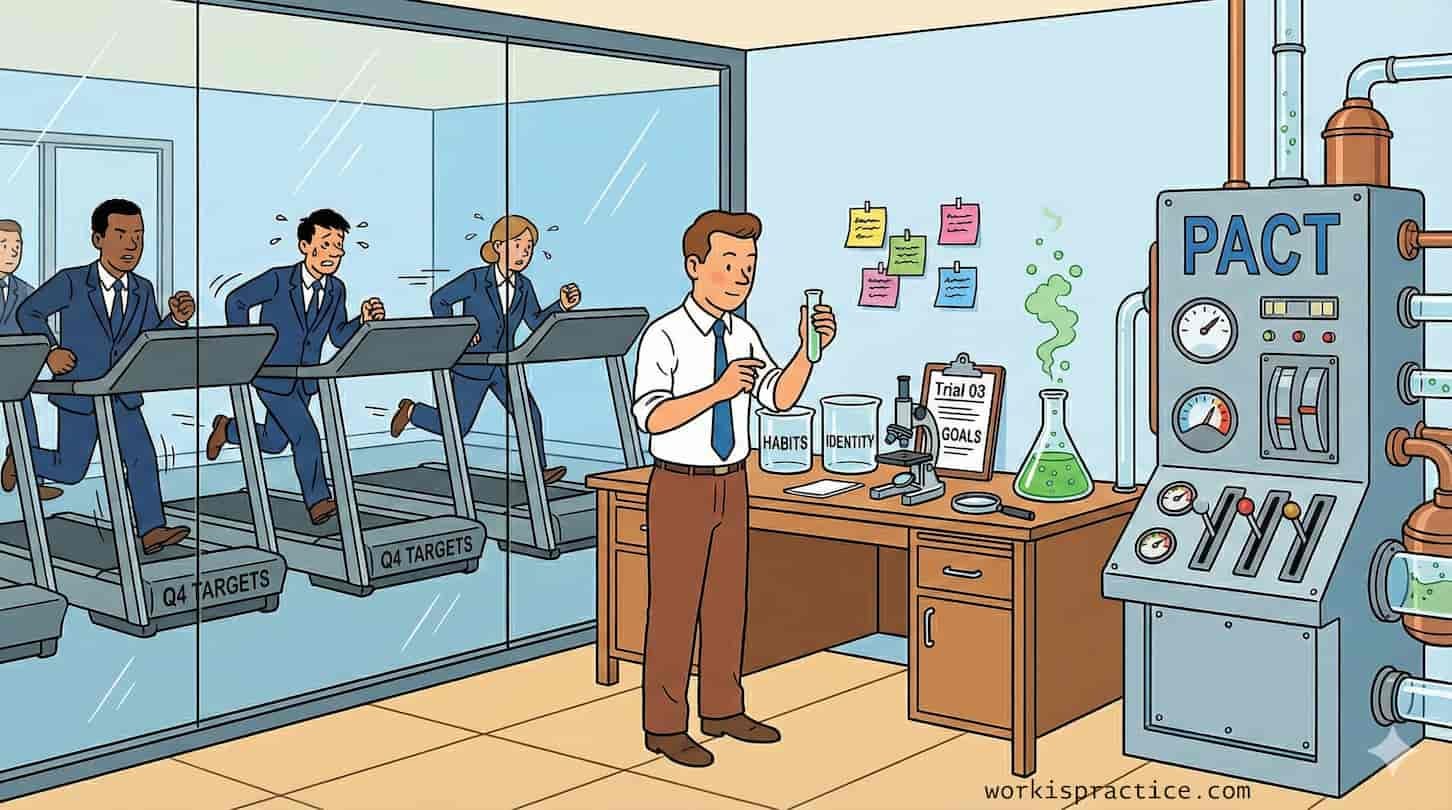
Anne-Laure Le Cunff’s book Tiny Experiments proposes something radical: What if you stopped treating your life like a corporate retreat and started treating it like a science lab?
What if, instead of setting massive goals that make you feel like you’re failing a test you didn’t study for, you just ran some experiments to see what happens?
Sounds simple. Almost suspiciously simple. But here’s the thing: it works.
The Problem With Your Goals (Spoiler: They’re Terrible)
Traditional goal-setting operates on the assumption that you know exactly what you want and exactly how to get it. Which is hilarious, considering most of us can’t even decide what to watch on Netflix without scrolling for forty-five minutes and eventually settling on a show we’ve already seen.
Le Cunff identifies the core issue: we’re running on what she calls “cognitive scripts.”
These are the autopilot narratives we’ve internalized since childhood. The “Crowd-pleaser” script that tells you to chase whatever gets likes on LinkedIn. The “Epic” script that insists you must discover your One True Calling, as if your life is a Marvel origin story and you’re just waiting for the radioactive spider bite.
These scripts don’t just fail to help. They actively paralyze you.
Set a goal to write a novel, and suddenly you’re not writing anything because the distance between “zero words” and “publishable manuscript” feels like the gap between Earth and the heat death of the universe.
This is what Le Cunff calls the “Red Queen effect,” borrowed from Alice in Wonderland. You’re running as fast as you can just to stay in the same place, except you’re not even in Wonderland. You’re in a WeWork with bad coffee and motivational posters that make you want to scream.
Enter the Pact: Goals for People Who Hate Goals
The Pact formula is stupidly simple: “I will [action] for [duration].”
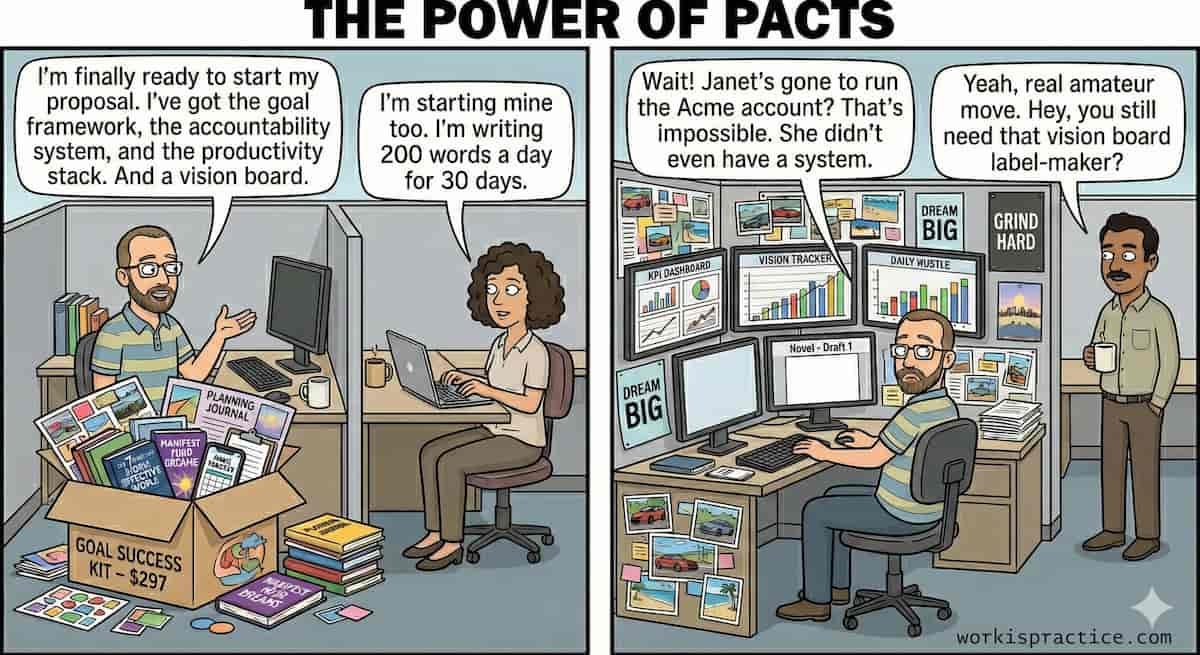
That’s it. No vision boards. No accountability coaches. No app that gamifies your existence until brushing your teeth feels like a side quest in a role-playing game you didn’t ask to play.
A pact isn’t about outcomes, which you can’t control. It’s about outputs, which you can.
This is what I mean when I say Work Is Practice. Not performance. Not identity theatre. Practice. Repeated, imperfect reps in public.
Instead of “I will get 5,000 newsletter subscribers” (translation: I will attach my self-worth to an algorithm I don’t understand), you commit to “I will publish one article every week for three months.”
I’m currently running my own pact: I will publish two articles a week for the next three months. Not grow. Not optimize. Not “build a platform.” Just ship twice a week and see what happens.
Success becomes binary. Did you do the thing? Yes or no. There’s no grading curve. No performance review where your manager asks you to “contextualize your impact” in a way that makes you sound like a TED Talk that achieved sentience.
You either showed up or you didn’t.
The Four Rules:
(Or How Not to Sabotage Yourself Immediately)
Le Cunff outlines four criteria for a successful pact:
1. Purposeful:
Your experiment should be driven by “warm curiosity.”
Not the cold, calculating curiosity of “will this make me money?” or “will this impress people at dinner parties?” Just genuine interest in seeing what happens. Like poking a sleeping cat. You’re not sure what will happen, but you’re curious enough to find out.
2. Actionable:
You need to be able to do it right now with what you already have.
Not after you buy the expensive course. Not after you clear your calendar for six months. Today. With your current bank account, your current schedule, and your current ability to focus for more than eight consecutive minutes.
3. Continuous:
You have to repeat it enough times to gather actual data.
One trial tells you nothing. Ten trials might tell you something. The serial-order effect suggests your later attempts will be better than your first ones, which means the garbage you produce on day one isn’t the final verdict on your capabilities. It’s just data from trial number one in a series that hasn’t finished yet.
4. Trackable:
Can you mark it done with a simple yes or no?
Not “I sort of did it” or “I did a version of it” or “I did something that could be interpreted as adjacent to it if you squint.” Binary. Digital. One or zero.
Duration
Because Your Brain Lies to You After Three Days
The duration component is where most people bail.
Three days into any new thing, your brain starts screaming that this is boring, pointless, and you should probably check Twitter instead.
Le Cunff recommends starting with a 10-day pact for brand-new experiments.
Long enough to notice patterns. Short enough that you can’t use “I don’t have time” as an excuse unless you’re genuinely in a coma.
For something you want to build on, go for one month or three months. This forces you through what she calls the “messy middle,” that phase where you’re past the initial excitement but not yet seeing results, and everything feels like you’re pushing a boulder uphill while wearing roller skates.
Plus Minus Next
The Reflection Tool That Isn’t Therapy
At the end of your pact, you run a simple reflection using what Le Cunff calls “Plus, Minus, Next”:
Plus: What worked? What brought you joy? What made you think “huh, that wasn’t as terrible as I expected”?
Minus: What sucked? Where did you faceplant? What made you want to throw your laptop out the window and become a shepherd in New Zealand?
Next: What will you try differently? Or will you even try again, or is this experiment getting filed under “interesting but ultimately not for me”?
This prevents the sunk cost fallacy, that lovely cognitive bias where you keep doing something you hate just because you’ve already invested time in it. Like staying in a movie that’s terrible because you already paid for the ticket. Or staying in a career that’s slowly draining your soul because you already have the degree.
You have permission to quit.
Permission to pivot.
Permission to admit that some experiments fail, and that’s literally the entire point of experiments.
Learning in Public
Or How to Weaponize Accountability
One principle Le Cunff emphasizes is “learning in public.” Share your works in progress. Share your false starts. Share the disasters.
This sounds terrifying, which is exactly why it works. Nothing motivates like the knowledge that strangers on the internet are watching you, judging you, and potentially screenshotting your failures for their group chats.
But more importantly, it builds community. Other people see your mess and think “oh thank god, I’m not the only one.” You’re giving them permission to be imperfect by being imperfect first.
Start Your Own Laboratory
Before You Read Another Self-Help Book
Look at your life as it actually is.
This one.
What’s one thing you’re curious about?
Not obsessed with. Not monetizing. Just mildly, stubbornly curious.
Turn it into a pact:
I will [action] for [duration].
Run it like a lab. Not like a referendum on your worth.
The problem isn’t identity.
It’s premature identity inflation.
Instead of announcing who you are becoming, base your identity change on data.
Run the reps. Collect the evidence. Let behavior make the argument.
If it works, you get momentum.
If it fails, you get data.
Either way, you move.
Goals make you dramatic.
Pacts make you dangerous.
Work Is Practice Field Note #002 The Red Queen Effect
The Red Queen Effect, borrowed from Alice in Wonderland, describes the sensation of running faster and faster just to stay in the same place.
You increase effort. You increase urgency. You increase ambition.
And yet nothing moves.
It feels like sprinting on a hamster wheel while your manager asks whether you’ve considered optimizing your stride.
Sometimes the problem isn’t speed.
It’s the wheel.