
Why Structure Is Kinder Than Motivation
Discipline has terrible PR.
Say the word and people picture a Navy SEAL doing burpees at sunrise, or a productivity bro on YouTube telling you to cold plunge until your personality changes.
No wonder creative people flinch. We’ve been trained to think discipline is punishment.
It isn’t.
What actually ruins your joy is friction.
The constant mental buffering wheel.
The endless decision fatigue that feels like trying to stream Netflix on hotel Wi-Fi.
I. The Real Exhaustion
Most days, you are not tired because you worked too hard.
You are tired because you made too many micro-decisions.
What to start.
What to avoid.
What to procrastinate on first.
What to feel guilty about later.
It’s like running 47 apps in the background and wondering why your battery dies at 2 p.m.
Discipline is not self-punishment.
It is shutting down the apps.
II. Why Motivation Keeps Betraying You
Motivation is delightful when it arrives, like a surprise package on your doorstep.
Unfortunately, it behaves like a delivery driver during the holidays.
It shows up whenever they feel like it, usually at the wrong address, and never when you actually need it.
If your creative life depends on motivation, it will remain a someday project you think about while scrolling TikTok.
Discipline asks only one question.
Is it time?
And weirdly, that simplicity feels like mercy.
III. Discipline as Kindness
Here is the reframe.
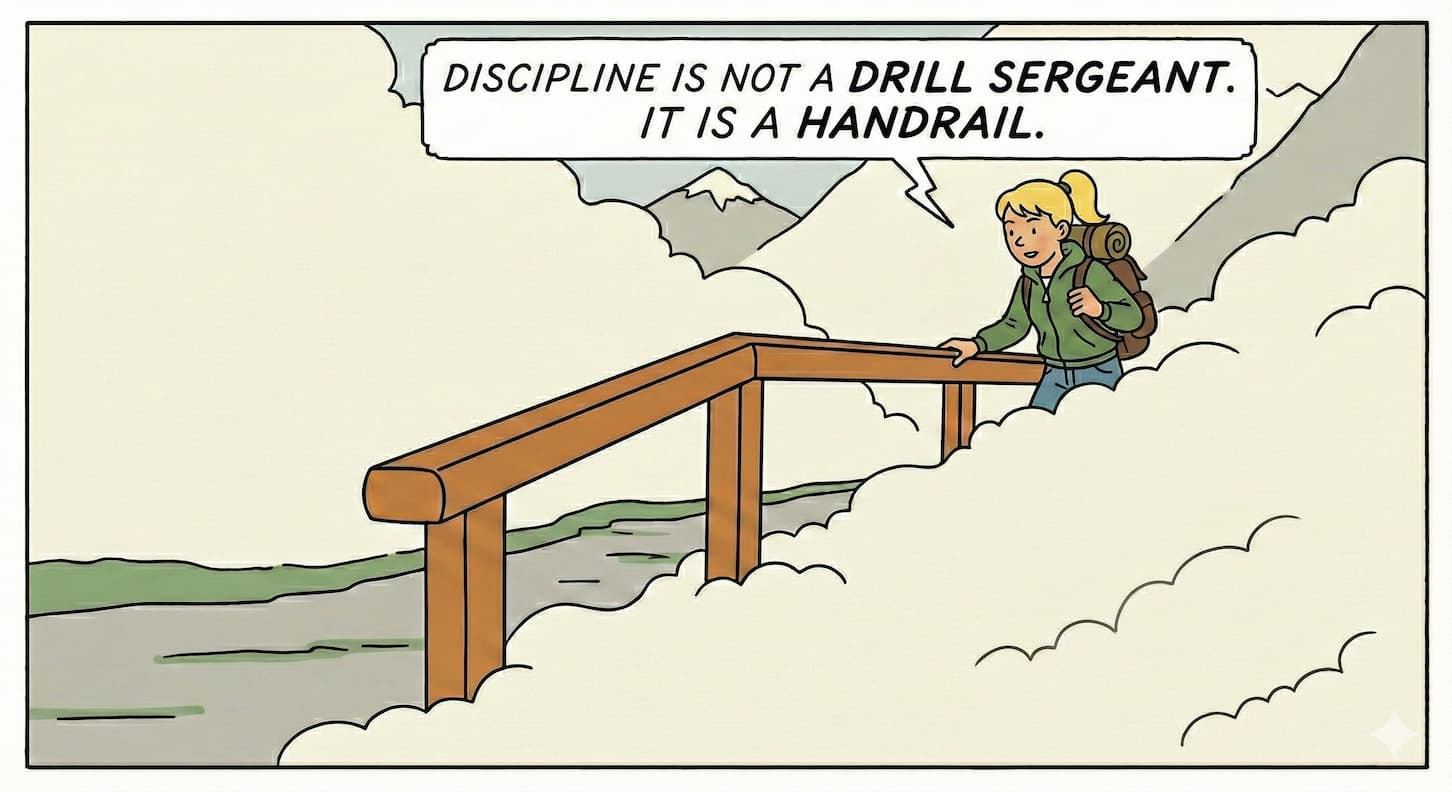
Discipline is not a drill sergeant.
It is a handrail.
It exists so you do not have to summon courage, confidence, or a sudden burst of main-character energy every time you want to do something meaningful.
A small, repeatable structure says:
You do not need to be brilliant today. You only need to show up.
Creativity thrives when it feels safe, not when it feels pressured to perform like it’s auditioning for America’s Got Talent.
IV. The Dojo Move
Today’s practice is intentionally tiny.
Choose one fixed time for one important thing.
Not every day.
Not forever.
Just this week.
Same time. Same place.
No drama. No reinvention. No TED Talk.
When the time arrives, begin.
Gently. Imperfectly. Without grading yourself like a high school English teacher.
Stop when the time ends.
Leave a little energy in the tank.
That is the whole move.
V. What Starts to Change
Something subtle shifts when you practice discipline this way.
You stop bargaining with yourself.
You stop resenting the work.
You stop treating creativity like a skittish raccoon that might run away if you breathe too loudly.
It becomes sturdier.
Quieter.
More dependable.
And joy returns not as excitement, but as ease.
VI. Exit the Building
Joy does not appear when you push harder.
It appears when resistance drops.
Discipline lowers the resistance.
It clears the path so your attention can settle, your work can deepen, and your evenings can belong to you again instead of disappearing into the black hole of “catching up.”
This is how the practice sustains itself.
Not through force.
Through kindness, repeated daily.
You do not need more motivation. You need fewer decisions.
Jey Jeyendran