
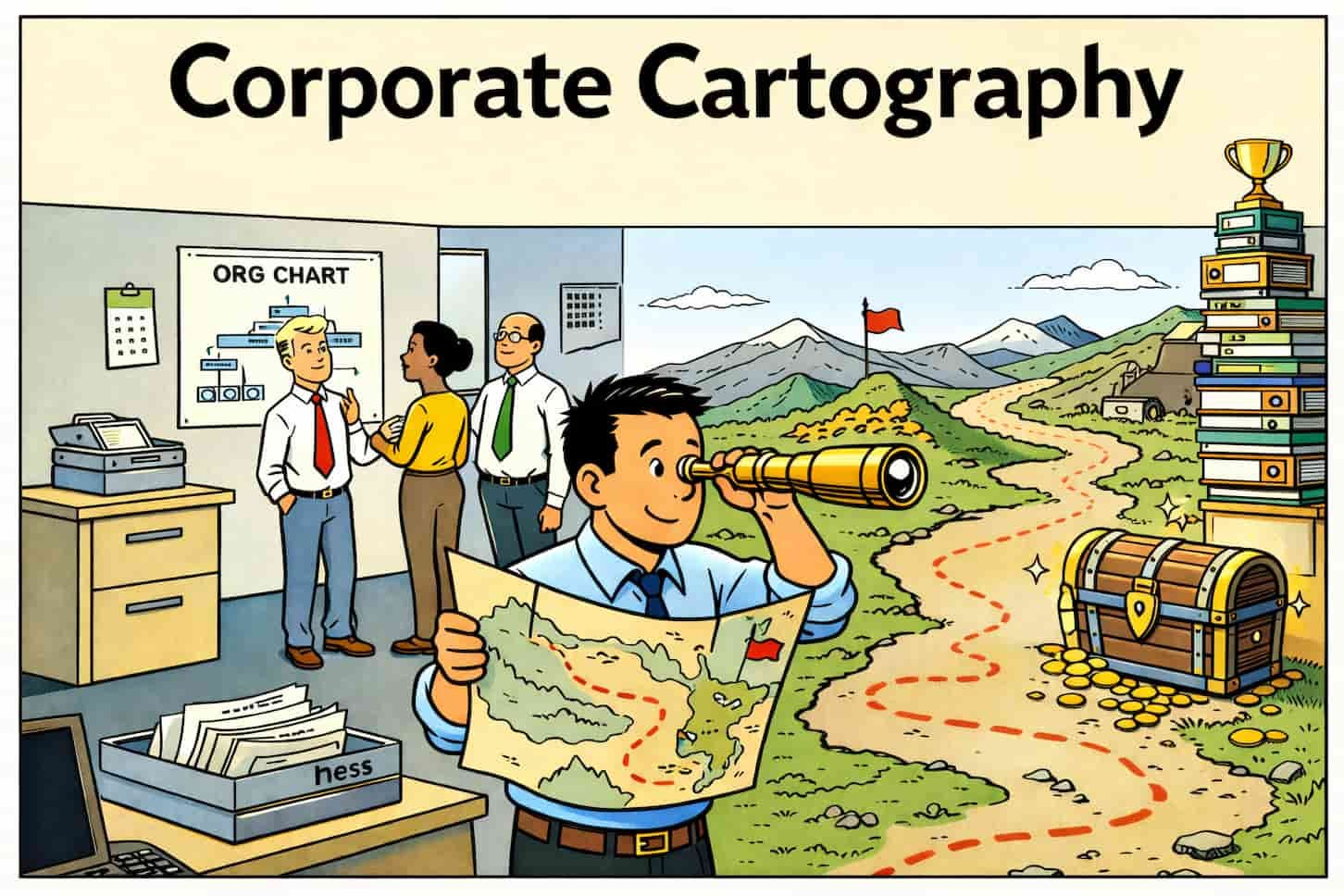
Why We Need A Map
Most of us were dropped into working life without a map.
We were given job titles, org charts, performance frameworks, inboxes, calendars, and acronyms. We were told where to stand, what to deliver, and how to behave.
What we were not given was the real map of the terrain we were expected to navigate. We were given an induction manual that bears zero relation to how your work really operates.
You’ve worked out fragments of how things really work. You know others have worked out fragments too. But no one has seen the whole picture. Until now.
Corporate Cartography is an attempt to draw that map.
Your mission is to map your work territory by naming things. Things that are not in the induction manual.
Why?
Because words have power. And when you name things you have power over them. You can see through the fog. You can find the treasure.
How to Play (or: make your own map)
From here, Corporate Cartography stops being something to read and starts being something to play with.
The game is very simple.
Pay attention to your working life.
Notice moments that feel familiar but oddly unnamed. Situations you recognise instantly but struggle to describe.
Then try to name one, using the name of a real country, county, town, city or village.
That’s it.
You’re not looking for the right name, or a clever one, or a funny one (though it can be). You’re just giving a label to something that already exists in your experience.
You want to make up your own word? Or use another category instead of place names? That’s fine, go for it.
Once something has a name:
you can notice when it’s happening
you can talk about it
you can decide what to do about it
Until then, it just quietly drains energy in the background.
If you’d like, you can:
share your map in the comments
swap notes with a friend or trusted colleague
or keep it private, like a field journal
Examples:
Chihuahua (n.)
A junior colleague who compensates for lack of experience with excessive enthusiasm, frequent Slack messages, and emojis in every sentence.
Kigali (n.)
The brief, euphoric moment when you think your calendar is free, only to realize Outlook hasn’t finished syncing.
Turku (v.)
To subtly rearrange your Zoom background to make yourself appear more intellectual, organized, or spiritually enlightened.
Osorno (n.)
The creeping dread that arises when your manager says, “Let’s circle back on this,” and you realize you’re the circle.
Bamako (n.)
The sound your soul makes when someone schedules a meeting at 4:30 p.m. on a Friday.
Yamagata (n.)
The mysterious force that causes all printers in the office to jam only when you’re already late for a presentation.
Bissau (n.)
The spreadsheet that claims to be “final” but has been revised 14 times and still contains a formula referencing a tab called “Old Stuff.”
Remember
There’s no leaderboard.
No canonical version.
No requirement to share anything publicly.
The point isn’t performance.
The point is attention.
Because once you can say “ah — this again”, you’re no longer lost in the terrain.
What’s the Prize?
There are two.
The Journey
Enjoy it.
The Treasure
You will know it when you find it.
Game on!
⸻
A note on origins
The spirit of Corporate Cartography draws inspiration from The Meaning of Liff by Douglas Adams and John Lloyd. In that book, they playfully repurposed place names that were “just lying around and not doing anything useful” to describe everyday situations for which no word previously existed.